

Choosing a silicone coated fiberglass fabric supplier is not simply a matter of selecting the lowest quotation. Industrial buyers must compare equivalent constructions, coating coverage, usable width, documentation, sample-to-bulk consistency, and delivery reliability before approving a supplier.
This guide provides a practical supplier evaluation method for procurement managers, equipment engineers, insulation contractors, and industrial fabric converters. It focuses on how to normalize quotations, evaluate technical capability, qualify samples, and reduce purchasing risk without duplicating a basic RFQ specification checklist.
Why Supplier Comparison Should Go Beyond Unit Price
A quotation is meaningful only when the compared materials have the same technical construction. Two suppliers may quote silicone-coated fiberglass fabric at different prices because they are offering different base cloth weights, finished thicknesses, coating sides, coating amounts, widths, or packaging conditions. Comparing the price per square meter alone can therefore produce the wrong decision.
The buyer should first confirm whether each quotation covers the same product definition. Check the fiberglass substrate, finished weight, nominal thickness, silicone coating configuration, effective width, roll length, color, and application. For a welding protection blanket, mechanical durability and surface behavior may be more important than a light catalog price. For a removable insulation cover, flexibility, sewing performance, dimensional stability, and repeatability may have greater impact on the total cost.
The purchasing decision should also include the cost of inspection, cutting waste, rework, freight, delayed production, and rejected material. A supplier with a slightly higher price may offer a more consistent construction, clearer technical documents, and lower risk during conversion. The objective is not to select the cheapest roll. It is to select a material and supplier combination that meets the engineering requirement at a predictable total cost.
Cost Factors to Include in the Comparison
When reviewing quotations, record the following cost factors separately:
- Quoted price basis: square meter, linear meter, roll, or finished part
- Finished width and usable width after edge trim
- Roll length and the number of splice points, if applicable
- Base fabric weight and finished material weight
- Single-side or double-side silicone coating
- Packaging, palletization, and export documentation
- Sample and testing charges
- Minimum order quantity and production setup charges
- Lead time and delivery terms
- Allowance for cutting waste and rejected material
This list does not replace a technical specification. It makes the commercial comparison more realistic after the technical equivalence has been established.
Which Technical Parameters Must Be Compared

The first stage of supplier evaluation is to create a like-for-like technical comparison. The key parameters are not limited to the product name. They describe the construction that will be delivered and the conditions under which it is expected to perform.
The base fiberglass fabric affects dimensional stability, tensile behavior, flexibility, tear resistance, and fabrication performance. Finished thickness affects clearances, overlap, compression, and the fit of an insulation cover or flexible assembly. Finished weight helps indicate the combined amount of substrate and coating, but it should not be used as a substitute for thickness or coating information.
The silicone coating should be identified by its coated sides, surface condition, adhesion, uniformity, and intended performance. If both faces will be exposed to handling, contamination, or contact with equipment, a double-side coating may be considered. If one face needs a protected surface while the construction must remain more flexible, a single-side construction may be more appropriate. The correct choice depends on the assembly, not simply on the lower quotation.
Minimum Technical Comparison Table
| Parameter | What the buyer should compare |
|---|---|
| Base fabric | Weave, construction, nominal weight, and existing reference grade |
| Finished thickness | Nominal value, tolerance, and measurement method |
| Finished weight | Nominal g/m2 and tolerance |
| Coating structure | Single-side or double-side silicone coating |
| Coating condition | Coverage, adhesion, surface defects, and consistency |
| Anchura | Nominal width, usable width, edge condition, and tolerance |
| Roll length | Standard or custom length and identification method |
| Flexibility | Handling, folding, sewing, wrapping, or movement requirements |
| Operating environment | Heat, sparks, moisture, oil, chemicals, abrasion, and vibration |
| Documents | Data sheet, certificate, test report, and batch traceability |
For a detailed RFQ checklist, see our custom silicone-coated fiberglass fabric specification guide.
How to Normalize Supplier Quotations
Before comparing prices, convert every quotation into the same evaluation format. Ask each supplier to state the product construction and commercial basis clearly. If one supplier quotes by linear meter and another quotes by square meter, convert the figures using the actual finished width. If one quotation includes delivery and another excludes it, record the difference separately instead of treating the two prices as directly comparable.
The same rule applies to coated sides and finished construction. A double-side coated fabric should not be compared with a single-side coated fabric as though they were identical. A heavier fabric should not be rejected only because its price per square meter is higher if it reduces rework, improves service life, or better matches the equipment design.
A normalized comparison sheet should include technical conformity, commercial terms, evidence, and unresolved questions. Mark missing information rather than assuming that an unspecified value is equivalent to the approved sample. This prevents a quotation with incomplete data from appearing more competitive than a quotation with full disclosure.
Supplier Quotation Comparison Template
| Evaluation item | Supplier A | Supplier B | Supplier C |
|---|---|---|---|
| Base fabric construction | |||
| Finished thickness and tolerance | |||
| Finished weight and tolerance | |||
| Coating sides | |||
| Effective width | |||
| Roll length | |||
| Sample status | |||
| Application-specific documents | |||
| Unit price basis | |||
| Packaging and delivery terms | |||
| MOQ and lead time | |||
| Batch traceability | |||
| Open technical questions |
The purpose of this table is not to create a universal scoring formula. It gives the purchasing and engineering teams a shared record of what has actually been offered.
How to Evaluate Samples Before Bulk Ordering
A sample should answer two questions: does the material match the required construction, and does it behave correctly in the intended fabrication process? A sample that looks acceptable on a desk may still be unsuitable when it is cut, sewn, wrapped, clamped, folded, or exposed to the operating environment.
Confirm whether the sample is a standard stock material or a representative production sample made to the quoted construction. Record its supplier reference, date, lot information, width, thickness, weight, coating sides, and any deviations. If the supplier offers a sample with a different width, coating amount, or base cloth, clearly label it as a preliminary sample rather than an approved production reference.
The evaluation should include the finished application whenever practical. For an insulation cover, inspect drape, folding, seam behavior, fastener compatibility, and fit around corners. For welding protection, inspect the surface after representative spark or spatter exposure under controlled safety procedures. For a flexible connector or expansion joint, review movement, clamping, abrasion, and installation clearance.
Sample Acceptance Questions
Before approving a sample, ask:
- Does the sample use the same base fabric as the quotation?
- Are the coating sides and surface finish the same as the proposed production material?
- Does the material meet the agreed thickness, weight, and width requirements?
- Can it be cut, sewn, folded, or clamped using the planned process?
- Does it retain acceptable flexibility after fabrication?
- Are the test conditions relevant to the actual application?
- What changes, if any, will be made before mass production?
- Will the approved sample be retained as the production reference?
For application-specific material selection, the buyer can refer to the existing silicone-coated fiberglass fabric selection guide.
How to Check Supplier Technical and Production Capability

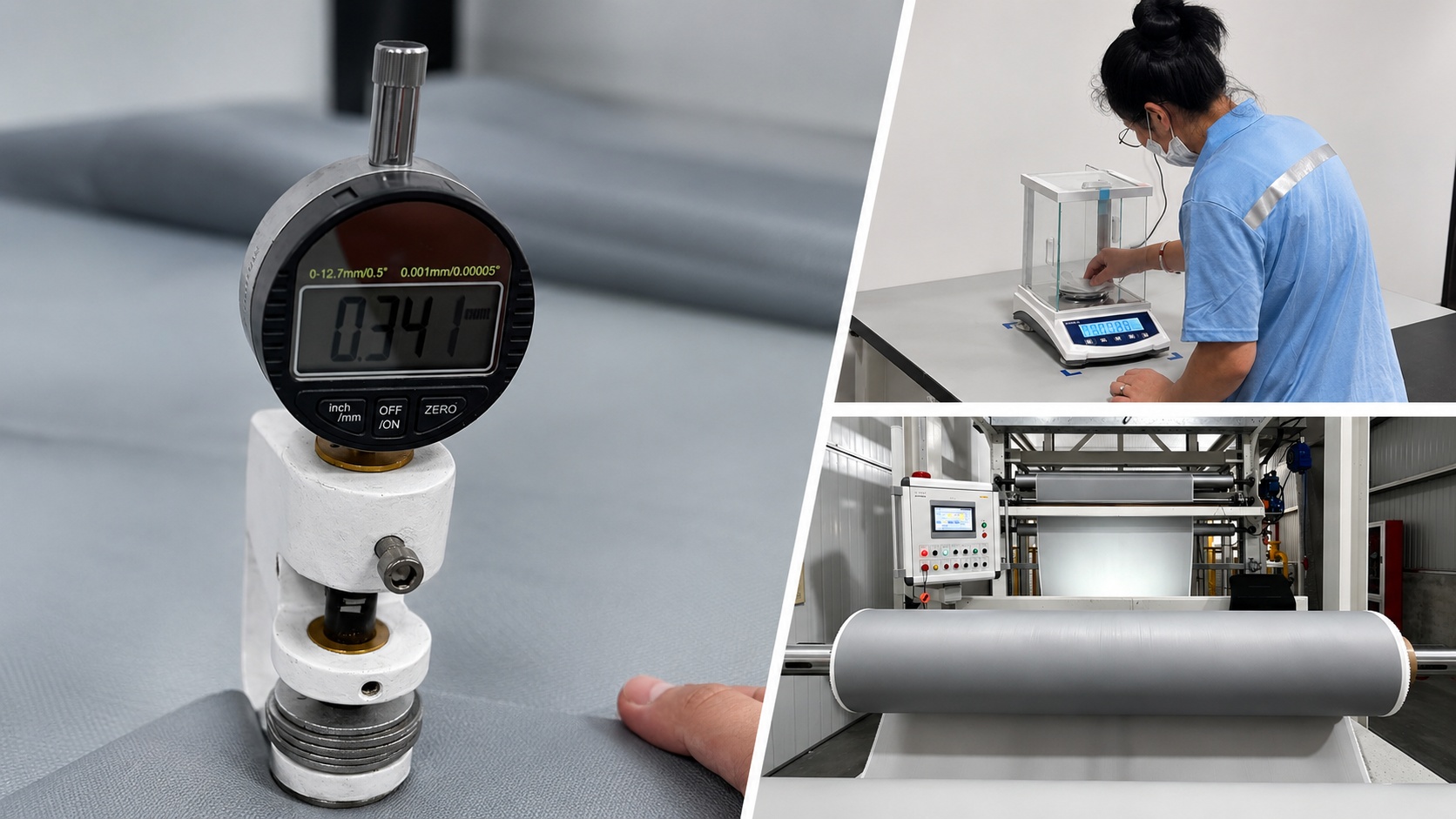
A capable supplier should be able to explain how the material is made, controlled, identified, and supplied repeatedly. The goal is not to demand every internal production detail. The goal is to determine whether the supplier can control the characteristics that matter to the buyer.
Request a technical data sheet that identifies the base fabric, finished construction, coating configuration, dimensions, and stated application guidance. Ask how thickness, weight, coating coverage, width, and appearance are inspected. If the material is safety-related or used in a controlled equipment assembly, request relevant test documentation and clarify whether the test applies to the complete coated fabric or only to the fiberglass substrate.
Production capability also includes the ability to handle custom widths, repeat orders, lot identification, packaging, and nonconforming material. A supplier that can provide a technically matched sample but cannot maintain the same construction in bulk creates a significant purchasing risk. The supplier should explain how approved samples are linked to production records and how changes are communicated before shipment.
Supplier Capability Checklist
Evaluate whether the supplier can provide:
- A representative sample linked to a defined product construction
- Clear identification of base fabric and coating configuration
- Consistent control of thickness, weight, width, and coating condition
- Application-relevant test reports or inspection records
- Batch or roll identification for traceability
- Custom width, roll length, color, or fabrication support when required
- A defined process for sample approval and engineering changes
- A documented response to nonconforming material
- Stable communication between sales, engineering, production, and quality teams
This is where a manufacturer may offer more useful technical control than a general reseller, but buyers should verify the claim through documents, samples, and production evidence rather than relying on the supplier description alone.
Sample-to-Bulk Consistency Is a Purchasing Risk

A technically acceptable sample does not automatically prove that the bulk shipment will be identical. The buyer should establish how sample approval will be connected to production. The approved sample should be retained, identified, and referenced in the purchase order or quality agreement. The order should also state the key characteristics that must remain within the agreed tolerance.
During the first production order, request the supplier’s inspection record or certificate for the relevant rolls. Compare the delivered material with the approved sample for surface condition, thickness, weight, width, flexibility, coating coverage, and visible defects. If the fabric will be converted into many finished parts, inspect enough material to identify roll-to-roll variation before large-scale cutting begins.
Consistency is not only a quality issue. It affects production yield, installation fit, replacement planning, and the reliability of finished covers, curtains, connectors, or barriers. A material that varies in stiffness or thickness may require changes to sewing settings, edge treatment, fasteners, or assembly clearances.
For a detailed inspection workflow, use the existing silicone-coated fiberglass fabric quality inspection checklist as the supporting page. The supplier evaluation process should define when that inspection is required and what evidence must be retained.
Common Supplier Selection Risks
Several purchasing risks appear repeatedly when buyers select silicone-coated fiberglass fabric only from a product name or headline specification. The first is comparing different constructions under the same description. A supplier may quote a lighter base cloth, a different coating side, or a different finished thickness without making the difference obvious in the commercial offer.
The second risk is treating a generic temperature statement as a complete application qualification. Actual performance depends on exposure type, duration, direct contact, air gaps, movement, flame, sparks, chemicals, and mechanical load. A supplier should explain the basis of its temperature guidance, and the buyer should assess the finished assembly rather than using one number as the entire design decision.
The third risk is approving a sample without checking fabrication. A fabric can appear suitable in roll form but create problems during cutting, sewing, folding, clamping, or repeated removal. The fourth risk is accepting incomplete documentation because the unit price is attractive. Missing batch identification or unclear tolerances can make later troubleshooting difficult.
A disciplined comparison process reduces these risks by requiring equivalent technical data, representative samples, documented acceptance criteria, and clear communication before bulk production.
Supplier Evaluation Checklist for Industrial Buyers
Use the following checklist before approving a silicone-coated fiberglass fabric supplier:
- The application and failure modes have been described to the supplier.
- The base fabric construction is identified.
- Finished thickness and weight are stated with tolerances where necessary.
- Coating sides and surface requirements are confirmed.
- Width is defined as nominal width or usable width, as appropriate.
- The quotation basis is clear and comparable with other offers.
- Delivery, packaging, MOQ, and lead time are recorded separately from technical data.
- The sample is identified and its production status is understood.
- The sample has been evaluated in the intended fabrication process.
- Relevant documents have been reviewed for scope and test conditions.
- Batch or roll traceability is available for the production order.
- Incoming inspection requirements are agreed before shipment.
- The supplier has explained how nonconforming material will be handled.
- Any proposed material change requires prior technical approval.
This checklist should be used as a purchasing control, not as a substitute for engineering validation. The required inspection depth depends on the safety impact, operating conditions, production volume, and cost of failure.
When to Request a Custom Quotation
A standard product quotation may be sufficient when the application matches an established fabric construction and the required width, coating, and packaging are readily available. A custom quotation is more appropriate when the equipment design requires a specific thickness, unusual width, special color, controlled coating side, cut parts, sewn covers, or a defined performance balance between flexibility and durability.
When requesting a custom quotation, provide the application, operating environment, approximate dimensions, expected quantity, fabrication method, and sample requirements. If the exact construction is not yet known, provide an existing sample, drawing, photograph, or description of the current material and explain the performance problem that must be solved.
For large-volume programs, request a production sample or pilot lot before committing to the full order. This gives the engineering and quality teams an opportunity to check fit, fabrication, handling, and inspection procedures. For more details on preparing a bulk-order request, refer to the custom silicone-coated fiberglass fabric bulk order guide.
Conclusion: Select the Supplier That Can Repeat the Requirement
Selecting a silicone-coated fiberglass fabric supplier is not a simple price comparison. The stronger procurement decision comes from comparing equivalent constructions, normalizing quotation terms, testing samples in the intended assembly, reviewing technical evidence, and confirming sample-to-bulk consistency.
A supplier should be able to explain what is being quoted, how the material is controlled, which documents support the application, and how production changes or nonconforming rolls will be handled. Buyers should retain the approved sample, define incoming inspection criteria, and link the purchase order to the agreed technical construction.
This approach helps procurement teams reduce rework, avoid hidden specification differences, and select a supplier that can support repeat production. When the required width, coating structure, finished thickness, or application conditions are outside standard products, send the supplier the equipment details and request a technically matched sample before placing a bulk order. Record the final approval decision so future buyers can reorder against the same reference.
Preguntas frecuentes
Should industrial buyers choose the lowest silicone-coated fiberglass fabric quotation?
Not automatically. The quotations should first be normalized by base fabric, finished thickness, weight, coating sides, width, delivery terms, documentation, and sample status. A lower price for a different construction is not a valid comparison.
What should be checked before approving a supplier sample?
Check the material construction, dimensions, coating condition, flexibility, fabrication behavior, relevant test evidence, and whether the sample represents the proposed production material. Retain the approved sample as a reference for the first bulk order.
Why is sample-to-bulk consistency important?
Variation in thickness, weight, stiffness, width, or coating condition can affect cutting yield, sewing, fit, installation, and service life. The approved sample and the production order should be connected through clear identification and acceptance criteria.
When is a custom quotation necessary?
Request a custom quotation when the project requires a non-standard width, thickness, coating configuration, color, cut part, sewn cover, special packaging, or an application-specific performance balance that is not covered by a standard product.

 Spanish
 English
 Russian
 Italian
 Arabic
 Portuguese
 German