

When requesting a quotation for custom silicone coated fiberglass fabric, simply asking for “silicone fiberglass cloth” is usually not enough. Different coating structures, fabric weights, thicknesses, widths, colors, and operating conditions can result in very different material constructions.
Providing clear specifications at the RFQ stage helps the manufacturer understand your application, recommend a suitable construction, prepare an accurate quotation, and reduce unnecessary sample revisions.
Before sending your inquiry, buyers can first review available silicone coated fiberglass fabric options and then prepare the following technical and commercial information.
Why Specifications Matter for Custom Silicone Coated Fiberglass Fabric
Silicone coated fiberglass fabric is not a single fixed product. The final material can vary according to the fiberglass base fabric, silicone coating structure, finished thickness, width, color, and intended application.
For industrial buyers, a complete specification helps avoid several common purchasing problems:
- Receiving a material that is too heavy or too light for the application
- Selecting an unsuitable single-sided or double-sided coating structure
- Using the wrong width or roll length for production
- Comparing quotations based on different material constructions
- Delays caused by repeated technical clarification
- Ordering samples that do not match the final bulk requirement
A clear RFQ allows both the buyer and supplier to compare the same technical requirements from the beginning.
1. Specify Single-Sided or Double-Sided Silicone Coating
One of the first details buyers should confirm is whether silicone coating is required on one side or both sides of the fiberglass fabric.
Single-Sided Coating
Single-sided silicone coating may be suitable when only one surface requires silicone protection or when the construction needs to remain relatively lightweight and flexible.
Double-Sided Coating
Double-sided coating is often considered when both surfaces require protection, improved handling, sealing performance, or exposure resistance.
If you are not sure which construction is appropriate, provide the intended application and working conditions instead of selecting a coating structure only by appearance or price.
2. Confirm Base Fabric Weight and Finished Thickness
The fiberglass base fabric has a direct influence on mechanical strength, flexibility, handling, and the finished construction of the coated material.
When requesting a quotation, specify either:
- The required base fiberglass fabric weight
- The required finished material thickness
- An existing specification or sample that needs to be matched
If only finished thickness is known, tell the supplier that clearly. If both base fabric weight and finished thickness are specified, the quotation can usually be matched more accurately to the requested construction.
For replacement projects, buyers should also provide the specification of the material currently in use whenever possible.
3. Specify Silicone Coating Weight or Coating Requirement
The amount of silicone coating can affect surface coverage, flexibility, abrasion resistance, sealing performance, and overall finished weight.
If your engineering drawing or existing product specification includes a coating weight requirement, include it in the RFQ.
If no exact coating weight is available, describe the expected performance instead, such as:
- Light coating for flexibility
- Good surface coverage
- Higher abrasion resistance
- Improved moisture or weather resistance
- Coating on one side or both sides
The manufacturer can then recommend a more appropriate construction based on the application.
4. Confirm Fabric Width, Roll Length and Color
Dimensions are important for both production efficiency and quotation accuracy.
A complete request should include:
- Required fabric width
- Required roll length
- Preferred color
- Any cutting or special dimensional requirement
For buyers using the material to manufacture insulation covers, flexible connectors, welding protection products, or other fabricated components, the required width should ideally be confirmed according to the production layout before bulk ordering.
Custom dimensions may affect manufacturing arrangements, minimum order quantity, packaging, and delivery time, so they should be communicated at the quotation stage rather than after the order is placed.
5. Define Operating Temperature and Application Conditions
A temperature requirement should not be provided without application context.
When discussing operating conditions, buyers should explain:
- Normal working temperature
- Whether there is short-term peak heat exposure
- Whether the material contacts a hot surface directly
- Whether the material is used indoors or outdoors
- Whether moisture, oil, chemicals, vibration, or abrasion are present
- Whether flexibility or repeated movement is required
Two applications operating at similar temperatures may still require different fabric constructions because their mechanical and environmental conditions are different.
If you are still determining which construction is appropriate for your application, see our guide on how to choose silicone coated fiberglass fabric before finalizing the RFQ.
6. Provide Order Quantity and Sample Requirements
Quantity is another important part of a custom quotation.
Buyers should specify whether the request is for:
- Sample evaluation
- Trial order
- Regular bulk purchasing
- A one-time project requirement
If a sample is required before bulk production, explain whether you need a standard available sample or a sample manufactured according to the final custom specification.
This distinction is important because a standard sample may be useful for checking general material quality, while a customized sample is more appropriate when specific thickness, coating, width, or color requirements must be verified.
7. Confirm Packaging and Other Custom Requirements
Packaging requirements are often overlooked during the initial inquiry but can become important for export orders and downstream production.
Depending on the project, buyers may need to specify:
- Individual roll packaging
- Required roll identification or labels
- Special pallet or carton requirements
- Shipping marks
- Customer-specific labeling
- Other documentation required with the shipment
If the material will be supplied continuously for a production program, it is also useful to confirm how each batch or roll should be identified for internal traceability.
RFQ Checklist for Custom Silicone Coated Fiberglass Fabric
Before sending an inquiry, buyers can use the following checklist to organize the required information.
| Specification | Information to Provide |
|---|---|
| Coating Structure | Single-sided or double-sided silicone coating |
| Base Fabric | Required fiberglass fabric weight or existing specification |
| Finished Thickness | Required total material thickness |
| Silicone Coating | Coating weight or required surface performance, if known |
| Ширина | Required finished width |
| Roll Length | Required length per roll |
| Color | Required or preferred silicone coating color |
| Temperature | Normal operating temperature and short-term heat exposure, if applicable |
| Application | Insulation cover, flexible connector, welding protection, expansion joint, or other use |
| Quantity | Sample, trial order, project quantity, or regular bulk requirement |
| Packaging | Roll packaging, labels, shipping marks, or other special requirements |
Check Quality Before Placing a Bulk Order
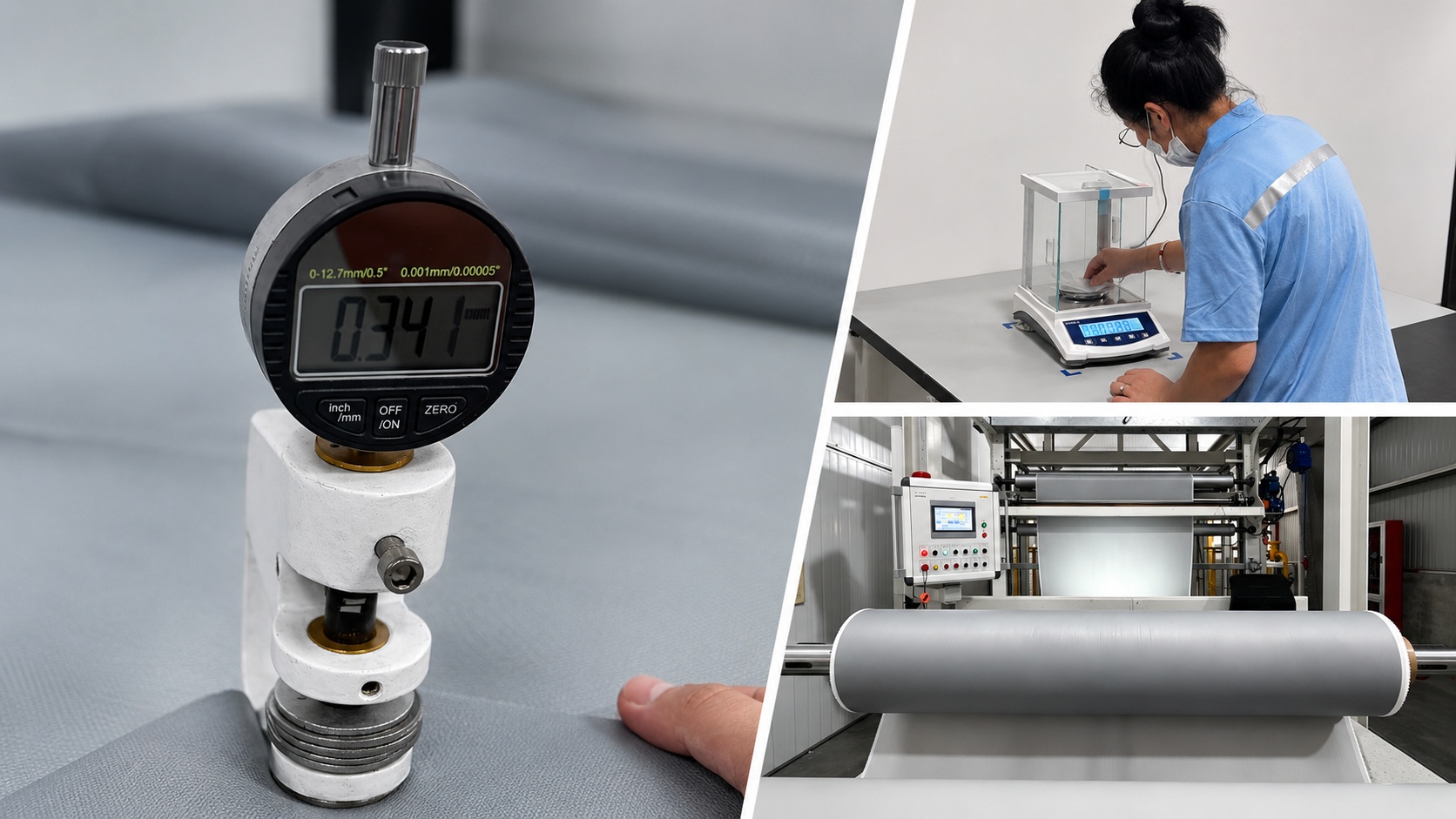
Once the specification has been confirmed, buyers should make sure that the sample or production material is evaluated against the agreed requirements before large-volume purchasing.
Important checks may include finished thickness, width, weight, coating consistency, surface condition, roll quality, and conformity with the approved sample or specification.
For a more detailed pre-purchase inspection process, read our silicone coated fiberglass fabric quality inspection guide.
Conclusion
A good custom silicone coated fiberglass fabric RFQ should provide more than a product name. Coating side, base fabric, finished thickness, coating requirement, width, roll length, color, operating conditions, application, quantity, and packaging can all affect the final material and quotation.
The more clearly these requirements are defined at the beginning, the easier it is for the supplier to recommend the correct construction, prepare samples, and provide an accurate quotation.
If some specifications are not yet confirmed, provide your application, working conditions, required dimensions, and expected order quantity. Our team can review the information and help determine a suitable material construction.
Contact us for a custom quotation and include your required specifications, application details, sample requirements, and estimated order quantity.

 Russian
  English
  Spanish
  Italian
  Arabic
  Portuguese
  German